Google just shipped "vibe design" — AI handles the spacing, the nesting, the layout logic while you focus on intent. After 16 years in the field, I'm not worried about the tool. I'm worried about what we lose when we name the craft something you're not supposed to think about.
A few weeks ago, Google shipped a major update to Stitch, their AI design tool. The headline feature was a real-time AI design agent and multiplayer editing. But the thing that stuck with me wasn't the feature — it was the word they chose to describe the experience.
They called it "vibe design."
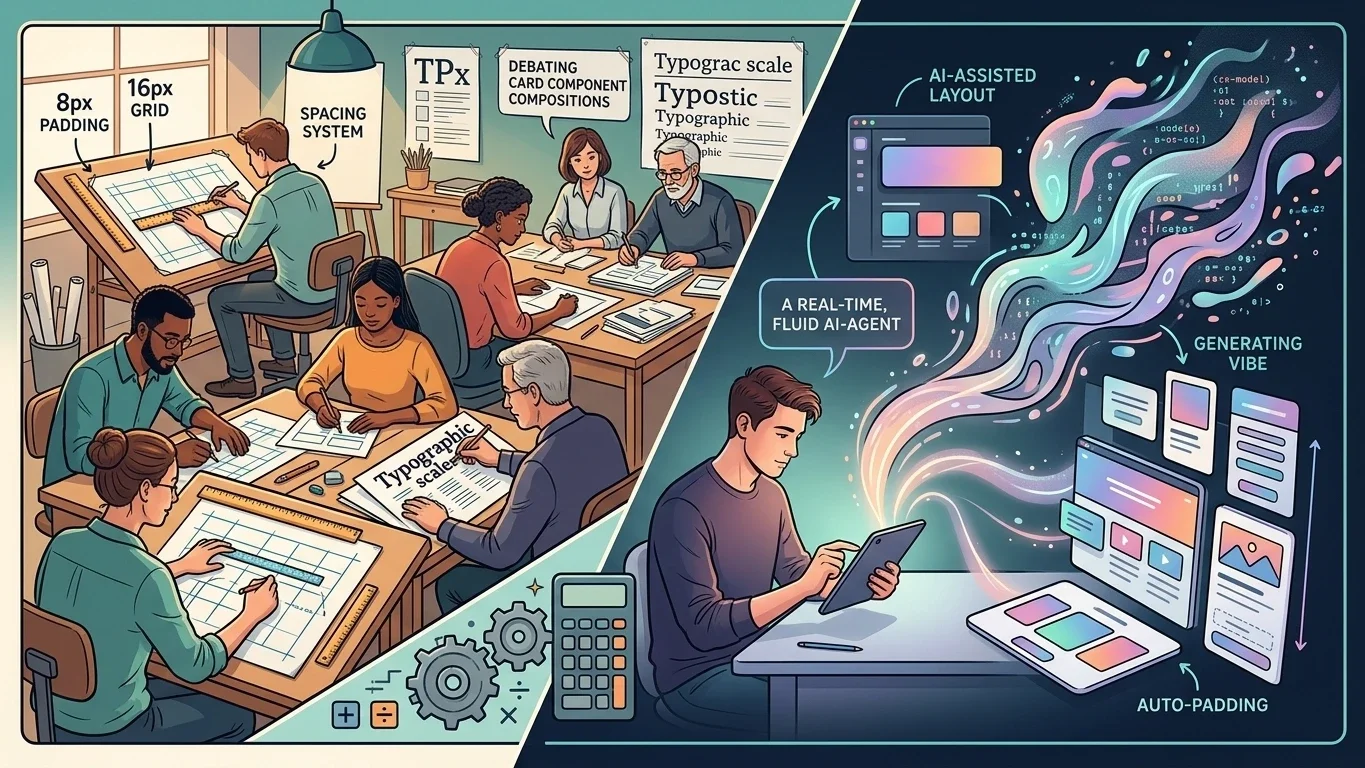
The idea is simple: you focus on the look, feel, and intent of what you want to build. The AI handles the padding, the component nesting, the spacing system, the layout logic. You bring the vision. The tool handles the craft.
I've been designing products for 16 years. I've watched tools get better, faster, and smarter in ways that genuinely improved my work. So I'm not writing this to complain about AI or to defend the old way of doing things. I'm writing this because "vibe design" — the name, specifically — reveals an assumption that I think is wrong. And if that assumption gets baked into how we train the next generation of designers, we're going to feel the consequences in about three years.
What "vibe" actually means
"Vibe design" is a direct parallel to "vibe coding," a term that got popular in the last year or so. In vibe coding, you describe what you want to build in plain language, and the AI writes the code. You don't need to understand the implementation. You just need to have a clear intent and a willingness to iterate.
For certain use cases, this is genuinely useful. Prototyping an idea quickly. Exploring a concept without committing engineering hours. Getting something on screen fast enough to have a real conversation about it.
But here's what happened with vibe coding in practice: a lot of people shipped software they didn't understand. It worked until it didn't. And when it broke, they had no idea where to start. The AI generated the code; the human generated the intent. Nobody generated the understanding.
"Vibe design" is setting up the same dynamic, but in a discipline where the consequences are subtler and harder to trace.
The AI generated the code; the human generated the intent. Nobody generated the understanding.
— Roy Villasana
The craft isn't decoration
When you manually define a spacing system, you are making a series of decisions that encode a mental model. Why is the padding inside this card 16px and not 12px? Because 12px feels tight against this typography scale. Why does this component use 8px gap between elements? Because it belongs to a group of components that share that rhythm, and breaking it would create visual noise that users would feel even if they couldn't name it.
None of those decisions are arbitrary. They are the product of understanding how visual weight, density, and hierarchy interact with each other. The friction of making those decisions manually is not inefficiency. It is the process by which you develop the intuition to know when something is wrong.
When an AI handles those decisions for you, they still get made. The AI picks a value, assembles the component, outputs a layout that looks correct. And here is the problem: it often does look correct, at least at first glance. But "looks correct at first glance" is a very low bar for design work that is going to be used by real people under real conditions.
The problems show up later. The component that breaks in edge cases because the AI nested it in a way that doesn't account for dynamic content. The spacing that looks fine in a desktop prototype and falls apart on a small Android screen. The interaction state that was never considered because nobody had to think through the logic manually. These are not AI failures. They are the natural result of removing the thinking that the craft was forcing you to do.
Junior designers are the real stakes
I have worked with a lot of junior designers. The ones who grew the fastest all had something in common: they had struggled. They had tried to get a layout right and failed, looked at it for twenty minutes, changed the spacing, looked again, and slowly developed a sense for what was actually happening and why. That struggle was not a bug in their learning. It was the learning.
"Vibe design" tools, used without intention, will remove that struggle. And they will do it in a way that feels like a gift. The junior designer will prompt the tool, get a result that looks polished, and ship it. They will never have to defend a spacing decision in a design review because the AI made the decision for them. They will build a portfolio full of work that looks impressive and is backed by zero internalized knowledge.
Three years from now, those designers will be mid-level. They will be in design reviews with stakeholders who want to change something. They will need to explain why a decision was made, whether an alternative is viable, what the downstream consequences of a change would be. And they will not have the foundation to answer those questions confidently. Not because they are not smart, but because they were never forced to build it.
This is the hidden cost of tools that remove friction.
The analogy that keeps coming up
I keep thinking about calculators in math class.
When calculators became widely available, there was a real debate about whether students should be allowed to use them. The concern was not that calculators were bad tools. It was that if students used calculators before they understood what multiplication was, they would be able to get correct answers without understanding anything. And when the problem became too abstract for the calculator to handle, they would be stuck.
The resolution, at least in decent schools, was not to ban calculators. It was to require that students demonstrate understanding first, then use calculators to work faster. The tool amplified capability that already existed. It did not substitute for capability that had never been built.
"Vibe design" tools are not bad. Google Stitch is genuinely impressive. The ability to go from an idea to a high-fidelity prototype in minutes is real value. But if you hand those tools to someone who has never had to think about why a layout works, you are giving them a calculator before they understand arithmetic. The output will look right. The understanding will not be there.
What this means for how we hire and teach
If you run a design team, this is a practical problem, not a philosophical one.
The standard hiring signals are already breaking down. A portfolio of polished, high-fidelity work no longer tells you whether the person who made it can think through a design problem. It tells you they can prompt an AI tool and iterate on the output. That is a skill, but it is a narrower skill than we used to be testing for.
The question to ask in interviews is not "walk me through your process." It is "tell me about a specific decision you made that you disagreed with on first instinct but came to understand later." That question requires genuine experience wrestling with design problems. It cannot be answered by someone who offloaded the wrestling to an AI.
If you are a design educator, the answer is not to ban AI tools from your curriculum. That is the wrong instinct. The answer is to structure learning so that students spend real time with the craft before they use the tools. Make them define a spacing system from scratch. Make them justify a hierarchy decision in writing. Make them redesign something that broke, by hand, and explain what was wrong. Then, once that foundation exists, introduce the AI tools and let them use them freely.
The goal is not to protect the craft for its own sake. The goal is to make sure the people using the tools actually understand what the tools are doing. Because the moment a design breaks in a way the AI did not anticipate, someone needs to be in the room who can identify the problem and fix it. That person needs to have built something by hand at some point.
The name tells you everything
I do not think Google named this "vibe design" by accident. It is a deliberate framing. Focus on the vibe. Let us handle the rest.
That framing is a great selling point. It is also a subtle argument that the rest does not need to be understood. That the details are an implementation problem, not a thinking problem.
But design is a thinking problem. The details are where the thinking lives. An 8px spacing decision is not a trivial implementation detail. It is the visible output of understanding how this component relates to everything around it. When you outsource that decision without understanding it, you do not just lose the decision. You lose the thinking that the decision was forcing you to do.
Vibe design will make a lot of things faster. It will lower the barrier to getting something on screen. It will help designers work at a scale that was not previously possible.
It will also, if we let it, produce a generation of designers who are very fast and very shallow. And that is a problem worth naming before it is already the default.