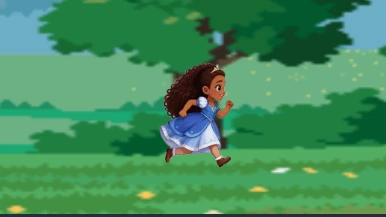
A story about parental guilt, a 5-year-old game director, zombie plants, and building something real together using AI tools — in three days.
There's a specific kind of guilt that comes with being a parent who works at a computer.
My daughter Juju sees me sitting at my desk, fingers on the keyboard, eyes on the screen — and she wants in. She wants to play. And more times than I'd like to admit, I've had to tell her "not right now." The look on her face when I do that is the kind of thing that stays with you.
So I decided to do something about it. Instead of choosing between work and play, I'd make them the same thing. We were going to build a video game — together.
It Started With a Flappy Bird
This wasn't our first attempt. A few months ago, on a lazy Saturday morning, Juju and I sat down and cloned Flappy Bird in a few hours. I called it Flappy Pink — pink everything, because she insisted. The moment she saw a version of herself flying across the screen, dodging obstacles, her eyes went wide. She couldn't believe that we made that. That she was in it.
That reaction was everything. She was hooked — not just on playing games, but on making them.
The Idea: Rapunzel Meets Mario Bros
Juju is almost six years old and her two great loves right now are Rapunzel and Mario Bros. So when we sat down to plan this new game, the answer kind of wrote itself: a 2D side-scrolling platformer starring her favorite Disney princess.
We called it Princess's Quest — La Princesa y el Castillo in Spanish.
The original concept was simple: run through one level, reach the castle, roll credits. Clean. Done. Easy.
Papá… that's it?
— Juju, age 5, reviewing the first prototype
She's five. Nearly six. And she wanted more. So I gave her more.
Building the Game: Three Days, Three AI Tools, One Very Opinionated Co-Director
Here's the honest breakdown of how this came together over three days, with Juju as my most demanding — and most enthusiastic — creative director.
Characters: ChatGPT + Autosprite
I started with ChatGPT to rough out the character designs — Rapunzel first, then a small puppy companion that was supposed to follow her through the levels. The puppy got cut in pre-production (Juju's call — "just Rapunzel, Papá").
But it became clear quickly that ChatGPT wasn't the right tool for pixel sprites. Getting clean, game-ready sprite sheets out of a language model is... a project in itself. I needed something purpose-built.
That's when I found Autosprite.io — an AI tool specifically made for generating game sprites and assets. It was exactly what we needed. From there we created:
- Juju — the second playable character, a pixel version of my daughter (she was thrilled)
- Two zombie plants — rooted enemies that snap at you as you pass
- A bat — classic platformer energy
- The final boss — Juju requested a forest Yeti with fangs and a crown. What we got back looked more like an angry orangutan wearing regalia. She approved immediately.
HUD: Nano Banana (Google AI Studio)
For the heads-up display — health bar, score, lives — I used Nano Banana inside Google AI Studio. Fast, clean output for the interface layer.
Implementation: Claude
By this point I had a working gameplay loop built in parallel and a full set of sprites. I handed everything to Claude and asked it to integrate all the assets into the existing codebase. It handled the implementation cleanly, respecting the structure I'd already built.
What We Ended Up With
A complete 2D platformer. Two playable characters. Four distinct enemies. A final boss encounter. A castle to reach.
No sound yet — that's the next chapter. But everything else works. You can play it right now and browse the code on GitHub.
Three days from blank canvas to finished game. And more importantly: three days of Juju sitting next to me, watching, deciding, laughing at the angry-orangutan Yeti she commissioned, and understanding — in her own five-year-old way — what it actually looks like to build something.
The Real Takeaway
I work with AI tools every day. I use them to design systems, build products, solve complex UX problems. But this project reminded me what they're actually for at the most human level: they lower the cost of making something, which means more people get to make things. Including a dad and his daughter who just want to spend time together.
Juju now tells her friends she's a game developer. She's not wrong.
The stack didn't matter. The tools were just tools. What mattered is that we made something real — something with her name on it, her face in it, her enemies in it — and she knows it exists because we built it together.
That's worth every late night debugging sprite collisions.